
Deed Types in Payette County
The Payette County Clerk serves as recorder for all property records. Its index groups conveyances with mortgages, releases, liens, surveys, subdivisions, leases, minutes, and miscellaneous instruments. A deed label only describes the instrument placed in the public record. It does not describe the full state of title. Read the parties, recording date, legal description, and image together.
| Deed Type | What It Does | Common Use |
|---|---|---|
| Warranty deed | Conveys the stated interest with covenants in the instrument | Ordinary arm's-length conveyances |
| Quitclaim deed | Transfers whatever interest the grantor has, if any | Family, estate, trust, or title cleanup |
| Personal representative deed | Conveys property through an authorized estate representative | Probate and estate administration |
| Trustee deed | Records a transfer made by a trustee | Trust administration or foreclosure context |
| Tax deed | Documents a completed county tax-deed transfer | Delinquent-tax proceedings |
Not every instrument conveys ownership. A mortgage or lien usually burdens an interest rather than transferring it. A release may later clear that indexed claim. Search those categories near each conveyance date. A deed alone may not reveal every recorded burden. A pending tax-deed notice also differs from a completed tax deed.
Search Payette Deeds Precisely
The official recorded-document search requires at least one criterion. The instrument number is the cleanest route. It is numeric, and it overrides every other entry. Name and description searches cast a wider net, while paired dates help control a large result set.
| Search Field | Format | Best Use |
|---|---|---|
| Instrument # | Numeric | Exact retrieval from a prior citation |
| Document Type | Named category or all types | Limit results to deeds, releases, liens, or surveys |
| Name | Last, First | Find a person or entity as a recorded party |
| Description | Subdivision, lot/block, or PLSS phrase | Follow the land when names change |
| From / To Date | mm/dd/yyyy, used together | Search a controlled transfer period |
The document-type choices include DEEDS, MORTGAGES, RELEASES, JUDGMENT/LIENS, LEASES, SURVEY/SUBDIVIS, COMMIS MINUTES, and MISCELLANEOUS. Start broad when the instrument class is uncertain. Then narrow. All terms in an overlong description may have to match, so a short, distinctive addition or section name often works better.
Check the county's recorder search instructions before using exact names or dates. That page preserves the official rules for each field.
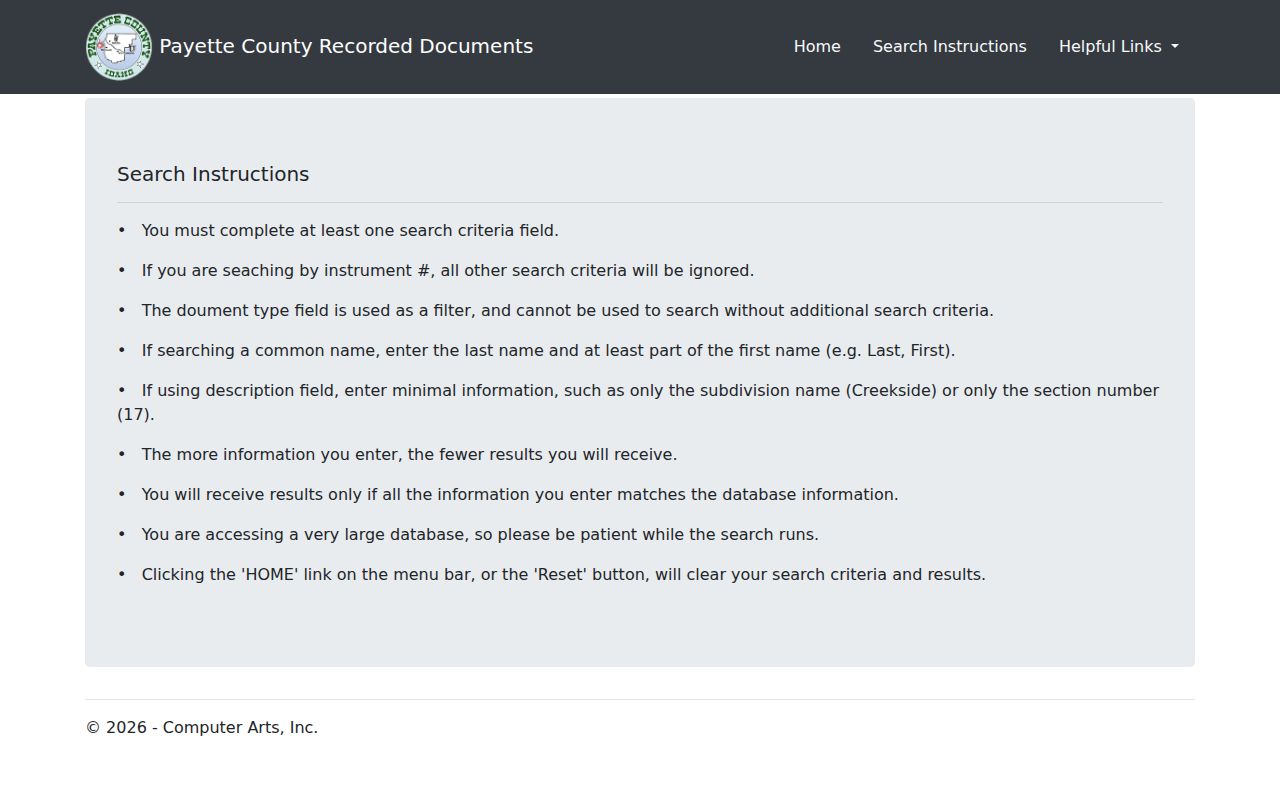
The instructions spell out the instrument-number override, comma-formatted names, paired dates, and exact-match behavior that shape an efficient deed search. Those details reward a minute of reading. Note: The official materials do not state the earliest year available in the live web index.
Read Payette Recorder Results
A results row is a finding aid, not the whole deed. Payette County displays the instrument number, recorded date, pages, party received from, associated name, document type, and description. Results sort with newer instrument numbers first. Open the detail and compare every identifier to the subject land.
The detail page lists the instrument number, old instrument number, page count, instrument date, transaction type, received-from name, section, township, range, legal description, image link, and grantor and grantee parties. That inventory lets a researcher reject a same-name result before relying on it. The sample instrument detail shows how much context sits behind one result row.
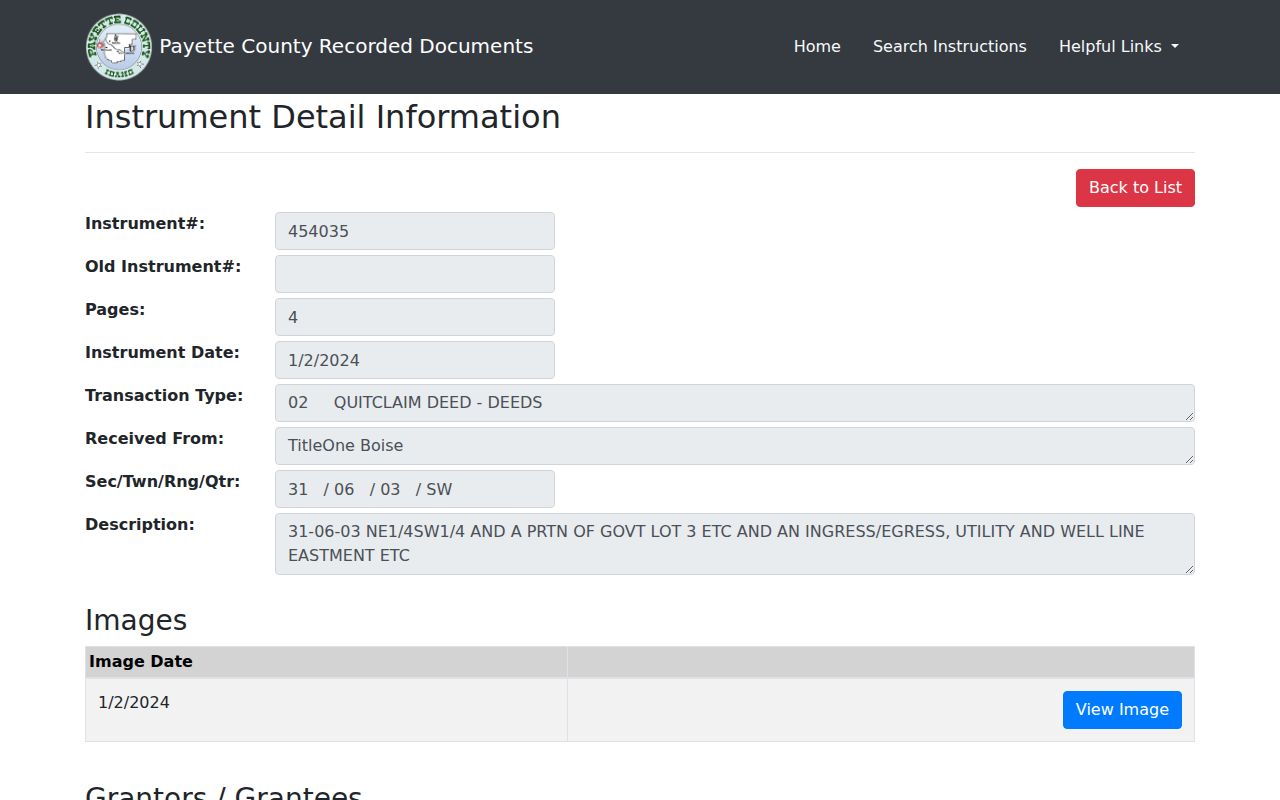
The indexed description includes ingress, egress, utility, and well-line easement language. That local example shows why the full legal description may matter more than the deed label itself.
Trace Payette County Grantors
A backward chain starts with the newest relevant conveyance. The grantee received the stated interest. The grantor transferred it. Those roles reverse the direction of a normal owner search. Keep the legal description constant while the party names change.
- Find the newest deed affecting the subject description and confirm its grantee.
- Read the grantor from that image, then search that person or entity as a grantee in an earlier range.
- Compare each legal description, plat reference, and parcel clue before adding the transfer to the chain.
- Repeat until the web index stops, then request the older book, microfilm, or predecessor-county index.
- Grantor
- The party transferring the stated interest.
- Grantee
- The party receiving the stated interest.
- Chain of title
- The linked sequence of conveyances affecting the same land.
- Book/page
- An older volume-and-page reference used to locate a recorded document.
- Instrument number
- A unique recorder index number for a filing.
Estate orders, entity changes, parcel splits, and boundary adjustments can interrupt a simple name-to-name trail. Search probate or court records when no deed explains an ownership change. When the land description itself changes, search the SURVEY/SUBDIVIS category.
Payette Deeds Before 1917
Payette County was formed in 1917, but the land-record trail reaches into the nineteenth century. For land in today's county, pre-1917 records may sit under Canyon County. Before Canyon County's 1891 formation, the trail may lead to Ada County. Do not expect a current Payette instrument sequence to expose every earlier filing.
The historical county page reports land records from 1865 to the present. It also points to older media and indexes. Homestead Declaration Book A spans 1882 through 1925, pages 1 through 247. Its index may reveal a declarant, spouse, children, marital status, and location clues. Those facts can unlock a deed search. A declaration, though, is no substitute for the conveyance itself.
Use the Payette County historical record notes and local microfilm. Treat archive holdings as finding aids too. Ask the Clerk which book or converted index covers your date and land description. FamilySearch's multi-county Idaho collection includes homestead patents from 1877 through 1952. It is not a complete Payette deed-book run, though.
Note: Record the county name that had jurisdiction on the filing date. Do not rely on the county shown on a modern map.
Plats Clarify Payette Deeds
Legal descriptions may use a subdivision, addition, or lot and block reference. They may also use a section-township-range reference instead of a street address. Search the recorder's SURVEY/SUBDIVIS category and compare the resulting plat with the deed description. Payette-area names such as Brown's Addition, South Park, Romine, Trees Addition, Court-side, Sunny Hill, Corsair, and Montessa can survive in recorded text. That survival can persist long after common address language changes.
A plat may show dedication, roads, easements, lots, and survey notes. It still must be tied to the correct recorded instrument. Modern county requirements for surveys and subdivisions include full-size Mylar, copies, and index data. They also cover surveyor or company details. Older records may follow a different format. Ask for the related index entry rather than assuming today's filing pattern.
Cross-Check Payette Encumbrances
A full encumbrance review reaches past the deed itself. Pull the mortgages, releases, and judgment or lien filings. These should touch the same parties across the same span of years. One release can point back to an earlier filing it extinguishes. A survey or subdivision plat often explains why a deed's land description shifted between recordings. Court dockets may clarify a quiet-title action or an estate transfer. The recorder image still remains the authoritative record of what was filed against the land.
Cross-check every way you can. Use the parcel PIN, the situs address, and the legal description as separate anchors. Names drift. Entity names change over time. A tax billing name can differ from a deed party. Sometimes no identifier is in hand. Then the general Payette County property search is the better place to begin.
Obtain a Payette County Deed
The recorder's detail page sometimes offers an image link. When it does not, contact the Payette County Clerk at 1130 3rd Ave N, Payette, Idaho 83661, or call 208-642-6000. Give the staff the instrument number, the parties, the recorded date, the document type, and the land description. Say whether you want a plain image, an inspection, a mailed copy, or a certified copy.
The county Clerk's forms list offers a general record request route. Payette County publishes no consolidated copy-fee schedule for recorder work, so request an estimate before ordering a long instrument or a broad historical range. Idaho public-record guidance gives resident requesters the first two labor hours and first 100 pages without charge in qualifying requests, with actual reasonable costs allowed after that. Certification charges may follow a separate service schedule.
Recorded is not guaranteed. The index shows what reached the recorder. It is not a title opinion, and unrecorded interests or unresolved defects may exist.
For a formal transaction, review the deed copy alongside all other required title evidence. The recorder records and preserves instruments. It does not certify, from the index alone, that title is clear.
If the web image is missing or unclear, use the county record-request route. Ask the Clerk to identify the controlling book, page, instrument, or converted index. For an older request, state the historical county as well as the modern parcel location. Keep the response, the fee estimate, the copy status, and any explanation of a missing volume together in your file. Idaho Public Records Act guidance also lets a requester seek the legal basis for a withholding. It likewise supports release of nonexempt portions. A deed image may be public while protected identifiers or unrelated attachments receive different treatment. Ask for the record itself, not a broad collection of personal data.
Log each request as you go. Record the date, the custodian, and the instrument. Note the promised format, the estimate, the payment, and the production date. Include the certification status too. That log distinguishes an index transcription from the actual filed image.
For a purchase or estate matter, preserve the downloaded image. Also keep the later certified copy reference. Do this whenever the transaction or the custodian requires formal certification.