
Compare Payette County Property Values
The word "value" covers more than one field. Payette County's assessor detail route shows Value History, Net Taxable Value, Land Details, Improvements, Ownership History, and Exemption History panels. A fair comparison copies the exact label, the exact year, and the exact amount, rather than blending them into a single estimate. Keep those labels intact.
| Value type | What the number represents | Official record |
|---|---|---|
| Assessed value | The assessor's value for the stated assessment year | Assessor account and value history |
| Market value concept | The full-value benchmark Idaho uses when studying assessment level and uniformity | Idaho Tax Commission ratio studies |
| Net taxable value | The value left after applicable exemptions or adjustments shown on the account | Assessor parcel detail |
| Sale consideration | The amount or consideration stated in a recorded transfer, when the instrument provides it | Recorder instrument image |
| Land and improvements | The account's separate components for land and built improvements | Assessor detail headings |
Idaho ratio studies weigh assessed values against sale prices. The tests show how level and uniform the countywide assessment is. That process never converts one assessed figure into a promised sale price. A transfer might also run between relatives, entities, or estate parties. The deed type alone cannot establish an arm's-length sale. So treat every indexed price with care.
Payette County Assessment Fields
The Payette County Assessor Property Search accepts a PIN. It also takes an owner name, a mailing address, or a physical address. PIN entries run 11 or 12 characters with no dashes or spaces. Once the right account opens, note General Information. Then check the value panels for the year in question. Ownership History and Value History answer different questions. One tracks account names and dates shown by the portal. The other tracks assessed amounts. Exemption History and Net Taxable Value explain why two similar assessed values can differ. They show how the taxable bases end up different too. Land Details and Improvements show whether a change sits in the site. They also reveal whether it sits in the buildings, or both.
Note: The official material does not disclose the exact parcel-card refresh cycle, so save the retrieval date with every figure.
Open Payette County Value Records
The official Assessor portal landing page is the county's access point. It lists contact details for the office alongside its public-information notice.
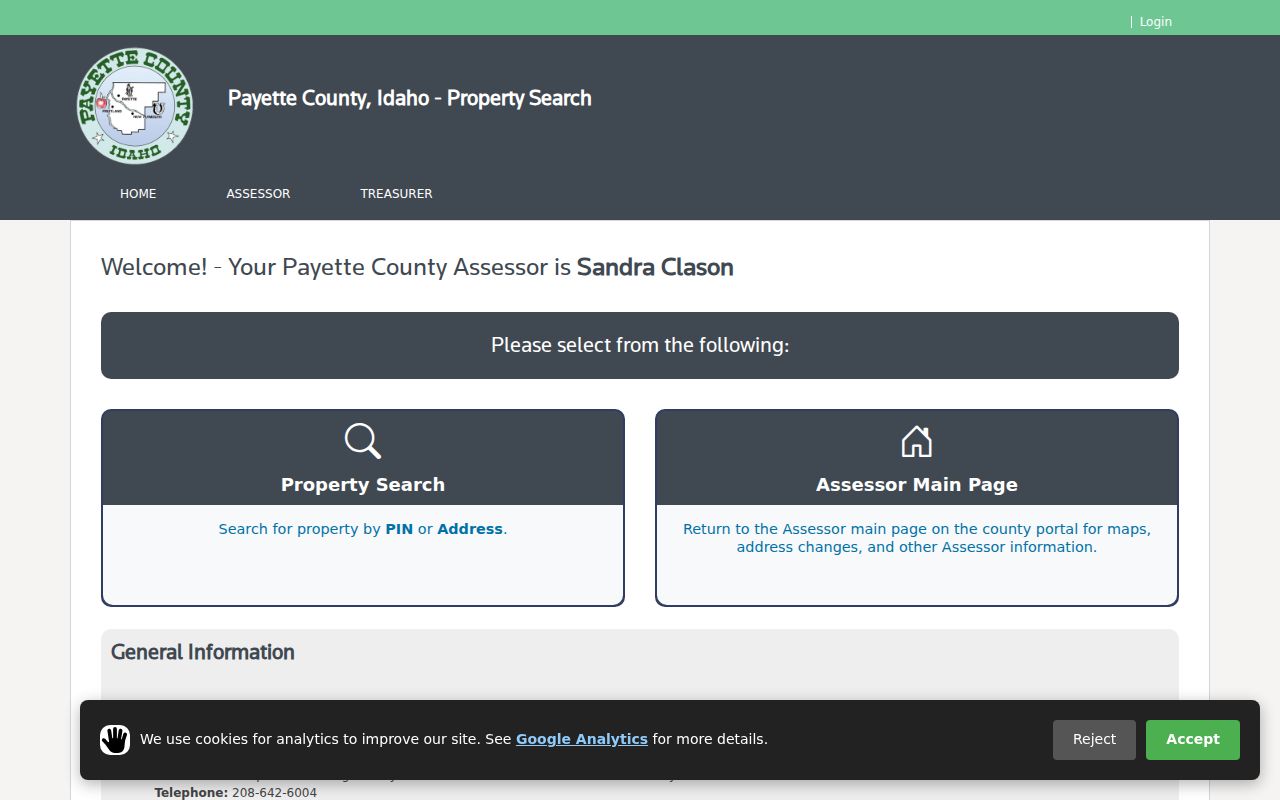
Treat the portal as the official record path, not a private appraisal. Save the account identifier, tax year, field label, and retrieval date. If a screen will not load, contact the Assessor at the courthouse. If a parcel will not appear, ask there too. Ask for the same fields by PIN and physical address.
Locate a Payette County Assessed Value
A short, logged search keeps each value tied to the right parcel. The search itself is only the entry point. The real goal is preserving the meaning and year of every number you pull.
- Search the physical address, or enter the complete county PIN without punctuation.
- Confirm the situs and legal description before copying any amount.
- Record Value History, land, improvements, exemptions, and Net Taxable Value by year.
- Open the latest relevant deed when recorded consideration or the transfer date matters.
- Note a split, merge, annexation, or major improvement before comparing years.
- Assessed value
- The value assigned by the assessor for a stated year.
- Market value
- An estimate of full value, not a guaranteed transaction price.
- Assessment ratio
- The relationship between assessed values and market indicators tested through ratio studies.
- Consideration
- The value exchanged in a conveyance when stated in the recorded instrument.
- Reassessment
- A new review or update of the assessed amount for a later roll.
Idaho Ratios and Payette County Value
The Idaho Tax Commission ratio-study material explains the assessment-level and uniformity concepts behind market comparisons. The state compares assessed values with qualifying sales. The result grades an assessment system. It does not price a specific Payette County home or tract. Keep any parcel comparison narrow. Match property type, location, condition, date, and parcel history. A nearby parcel may sit in a different tax code area. It may carry different improvements or hold an exemption. A recorded price can also reflect terms the index never shows. Those limits argue for preserving source labels, not for discarding the official values.
Exemptions Change Payette County Values
Idaho's homeowner exemption can reduce the taxable amount on a qualifying primary residence. The state applies it to 50 percent of the value of the home and up to one acre. That amount is subject to the current maximum. Check current eligibility and amounts with the Tax Commission and the Assessor. That reduction does not rewrite a sale price. It also should not be mistaken for a drop in the underlying assessed value. Compare Assessed Value, Exemption History, and Net Taxable Value as separate columns. For the bill, levy, due dates, or an appeal path, use the Payette County property tax records page. Do not stretch a valuation comparison into tax administration.
Payette County Sale Value Clues
The county recorder index supports searches by instrument number, document type, name, and description. It also pairs those with a date range. Open the instrument image whenever sale consideration matters. A result row or deed label alone may not state the full terms. A quitclaim deed, correction, estate transfer, or entity change can be recorded. It may not represent an ordinary open-market purchase. Read the parties, instrument date, legal description, and all continuation text. Sample instrument 454035 shows why. Its indexed description includes ingress and egress, utility, and well-line easement language. Such terms can shape a buyer's analysis. They never produce a new assessor value.
Compare Payette County Value Years
A sound trend follows the same parcel through time. Record the PIN. But watch for a parent tract divided into child parcels or parcels merged under a new identifier. Compare legal descriptions, land and improvement components, exemptions, and deed dates. City annexation or a new tax code area can shift the tax context. That shift alone proves no matching move in market price. No official city-only assessed-value series exists for Payette, Fruitland, or New Plymouth. Population estimates and hearing activity are development context, not dollar evidence. For a city property, pull the county account's own Value History. Pair it with dated transfers or planning events only where the records support that link.
Limits of Payette County Property Value
An assessed value in Payette County belongs to one tax year. That is its whole scope. It is not a title opinion, a boundary survey, or a building inspection. It is not a forecast of what a parcel will fetch at closing. The county GIS adds its own caution. It notes that assessment mapping does not guarantee parcel location or dimensions. When a value decision turns on acreage, access, zoning, water, or a recent improvement, those separate limits deserve real weight.
Value is not price. A Payette County assessed value supports taxation. It is not a professional appraisal or a promise of what the property would sell for.
When a current opinion of market value is required, use a licensed appraiser. For the official assessed and taxable fields, the assessor is the right office. The recorder holds the actual instrument. The Treasurer handles the tax account. Keeping those roles straight makes any Payette County property value comparison far more reliable. A licensed appraiser gives a current opinion of market value. The assessor keeps the official assessed and taxable fields.