
Trace Payette County Former Owners
Work one verified transfer per row. Never treat an assessor history entry as a complete title chain. Begin at the newest recorded conveyance that matches the land, then step back through older Payette County deed records as the dates demand.
| Transfer date | Grantor to grantee | Deed type | Book, page, or instrument |
|---|---|---|---|
| Newest matching date | Prior owner to apparent current owner | As indexed | Recorder instrument number |
| Next earlier date | Earlier owner to that prior owner | As indexed | Instrument or deed-book citation |
| Earlier link | Repeat the verified name sequence | As recorded | Book and page when available |
Copy the legal description every single time. A shared surname proves nothing after a subdivision, lot split, or boundary change. That description is the thread that keeps every former owner tied to the same Payette County land.
Search Payette Prior Owners
The Payette County recorder index gives you options. Instrument number wins on precision. For names, type Last, First and run the person through successive date windows. Choose DEEDS for the core transfer chain. Results show instrument number, recorded date, pages, received-from party, associated name, document type, and description, with a default descending sort by instrument number. Open the newest plausible deed and test its full legal description before adding its parties to your Payette County timeline.
Help is available. The recorder's official instruction screen walks through each search option.
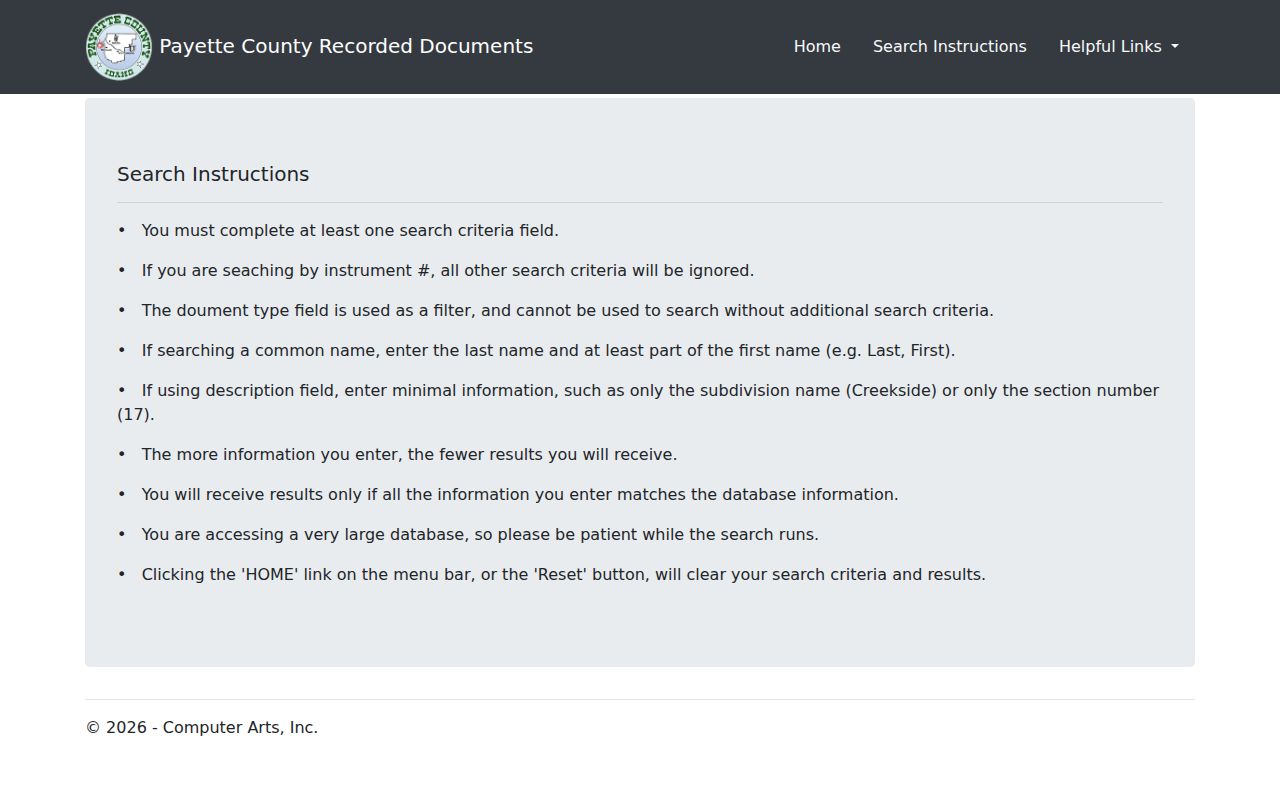
These exact-match notes favor short, controlled Payette County searches.
Reconstruct Payette Ownership Backward
Each recorded grantee links backward. Keep a worksheet beside the recorder index as you rebuild Payette County ownership. Search both party roles when the results hide who was grantor and who was grantee.
- Find the apparent current owner's acquiring deed. Verify its grantee, date, and complete land description.
- Take that deed's grantor as the next prior owner. Search that name as a grantee in an earlier period.
- Open the earlier acquiring deed and repeat. Track parcel splits, additions, easements, and name variants.
- When the web index stops producing verified links, continue through the Clerk, deed books, microfilm, predecessor counties, and archive aids.
- Grantor
- The party conveying an interest.
- Grantee
- The party receiving the interest.
- Chain of title
- The ordered sequence of transfers affecting the same land.
- Reverse index
- An index organized to help trace parties in the opposite conveyance role.
- Quitclaim deed
- A conveyance of whatever interest the grantor has, without a warranty of title.
- Warranty deed
- A deed carrying stated promises about title, subject to its terms.
Payette Online Deed Cutoff
No official county page states the earliest year in the live recorder index. Promising full historical coverage online would be wrong. A separate page lists land records from 1865. That coverage runs to the present, but treat it as an access lead rather than proof that every Payette County deed record sits on the web.
Online limit. Payette County's earliest web-index year is not published; use deed books, microfilm, and predecessor counties when online links end.
Ask the Clerk to pinpoint the deed book, page, index conversion, missing volume, or image route you need. The office sits at 1130 3rd Ave N, Payette. The general telephone is 208-642-6000. A focused request should carry names, date range, PIN, legal description, and any citation you already hold.
Payette Owners Before 1917
Payette County was formed in 1917. A prior-owner trail for land inside today's county can shift to Canyon County before 1917 and to Ada County before 1891. The office holding the record matters most.
Log three dates separately. The land event, the jurisdiction's creation, and the modern index's coverage are not the same thing. Boundaries moved, but records stayed put. A modern Payette sequence misses predecessor-county deeds. Search the old legal description and addition name, not only a modern street address.
Note: County formation changes the archive route, but it does not mean the land history began in 1917.
Payette Homestead Owner Clues
Declaration of Homestead Book A runs 1882 to 1925. It covers pages 1 through 247. Its index can surface a declarant, year, page, spouse, children, marital status, and location clues that point toward the next deed. The details can fix a spelling.
A homestead declaration is not a patent or conveyance. Treat it as a clue until a recorded instrument or archive citation confirms the land interest. The historical land index aids discovery, and the official record source should confirm it.
Follow Payette Addition Names
An old parcel answers to its addition name. Addition names outlast street renames. Local ordinance, hearing, and annexation material mentions Brown's Addition, South Park Addition, Romine, West-slope, Carpenters, Trees Addition, Tioga, Court-side, Sunny Hill, Corsair, Dewitt's First, and Montesa.
Try SURVEY/SUBDIVIS in the recorder index. Note the Payette County plat name, lot, block, dedication, roads, easements, and book or page. Then compare city annexation and ordinance records. New Plymouth's double-diamond original-townsite plan makes block and lot your best guides when a directional address falls short.
Extend Payette Former-Owner Research
FamilySearch offers a multi-county Idaho collection. Its homestead patents run from 1877 through 1952. The patents cover Adams, Canyon, Gem, Payette, and Washington counties. NARA's M1509 finding aid adds another federal microfilm lead. Neither source is a complete Payette County deed-book run.
Newspaper notices, directories, church and cemetery microfilm, and 1940 enumeration-district descriptions can yield a surname, addition, rural route, or address clue. Confirm with an official recorder image, deed-book citation, patent, or archive record before treating anyone as a Payette County owner of record.
Depth of Payette Owner Records
Payette County owner records can reach back before the county itself existed. No single source tells the whole story. The modern index, county books, microfilm, land patents, plats, directories, newspapers, and assessor history each cover a different slice. They do not merge into one database. So a blank result in one source rarely means no transfer ever happened. The deed may sit in a different county. It may sit under a different spelling, on microfilm, or under another legal-description form. Keep the chain honest as you work. Note the gaps you meet. Record where each fact came from. Note whether an image or certified copy backs it up. For one current deed copy, the deed-record process is the faster route, and the current owner page handles the present roll.
Lawful use. Research former owners for house history, estate work, or property diligence. Never use the record trail to stalk, harass, or harm anyone.