
Inside Payette Property Tax Records
Payette County property tax research goes more smoothly once you separate two jobs. The Assessor keeps the parcel account, along with the valuation history for each tax year. The Treasurer handles the money side, meaning district rates, bills, payment records, and delinquency. Match the PIN or AIN and tax year first. Compare figures only after that. Assessment and billing fields answer different questions about the same parcel.
| Field | What It Shows | Where |
|---|---|---|
| Value History | Parcel valuation by displayed year | Assessor detail |
| Land and Improvements | Components supporting the total | Assessor detail |
| Exemption History | Relief affecting taxable value | Assessor detail |
| Net Taxable Value | Value remaining after applicable relief | Assessor detail |
| Tax account and payment | Bill and payment context for the account | Treasurer search |
| Tax code area | Combined district-rate setting | Treasurer levy table |
Idaho requires assessment at market value, but the numbers stay separate. Roll value, net taxable value, and the tax bill each answer a different question. So does the consideration on a deed. A deed can recite nominal consideration. A bill reflects exemptions and stacked levies, not a simple percentage of a recent sale.
Search Payette Tax Accounts
The Payette County Treasurer search offers four ways in: PIN, owner name, mailing address, and physical address. The county suggests the PIN or AIN printed near the top middle of a tax bill when paying. That identifier cuts down same-name and similar-address errors.
| Search Choice | Input | Practical Use |
|---|---|---|
| PIN | Full parcel identifier | Match a known bill to one account |
| Owner Name | Person or entity name | Find candidate tax accounts |
| Mailing Address | Bill recipient address | Locate an account when situs differs |
| Physical Address | Property street address | Start from the land itself |
The official Treasurer tax search below opens the county account and shows which search modes it accepts.
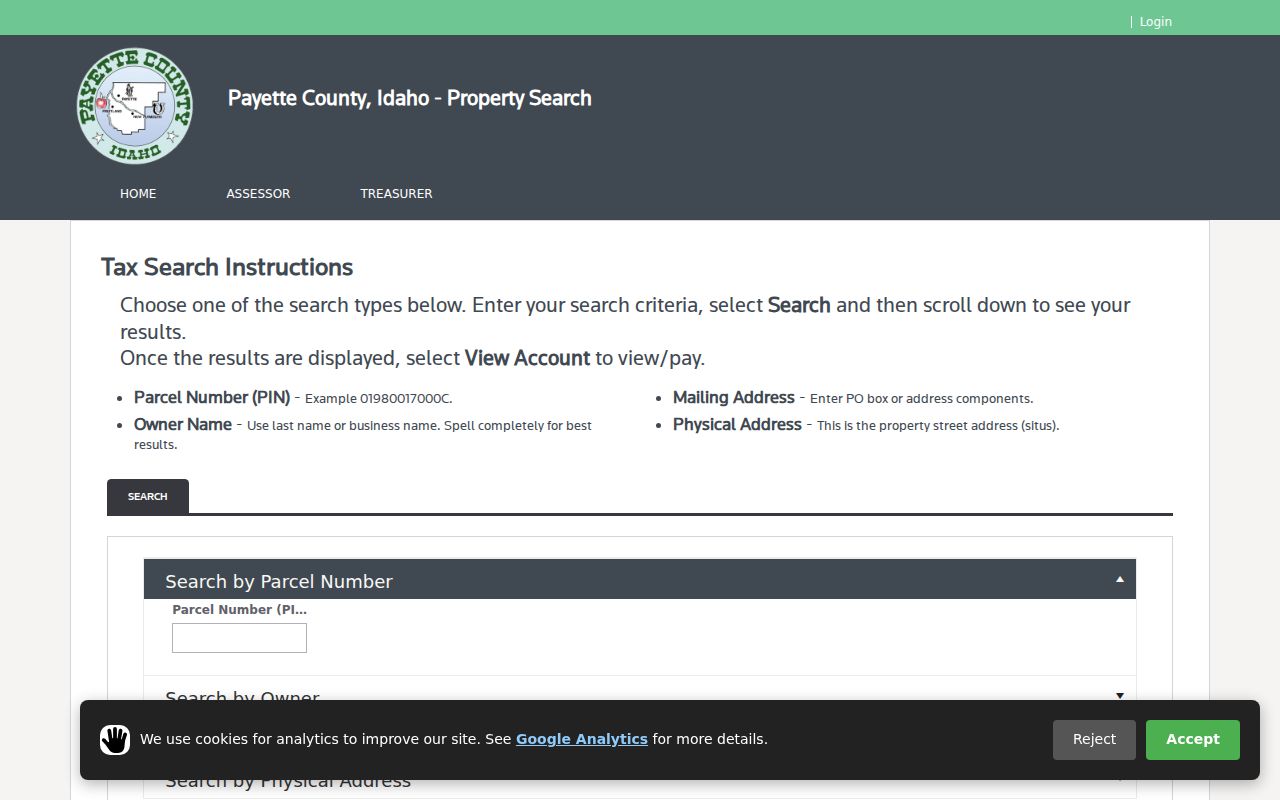
Take the identifier from that result and open the matching assessment record too. A mailing address is not always the situs, since a bill can be sent elsewhere.
Follow a Payette Tax Bill
A sound review keeps four things together: parcel, tax year, value year, and payment status. Save a copy of what you pull. A later payment, correction, exemption, or account update can change the online record.
- Search the Treasurer portal by the complete PIN when available. Otherwise use a physical address and verify the returned legal description.
- Record the tax year, amounts, payment information, and tax code area exactly as displayed.
- Open the assessor account and compare Value History, Exemption History, and Net Taxable Value for the related valuation year.
- If delinquency appears, ask whether the matter is a balance, a pending tax-deed process, or a completed tax deed.
- Assessed value
- The value placed on the assessment roll.
- Levy rate
- The combined rate tied to the parcel's tax code area.
- Homeowner exemption
- Qualifying primary-home relief that reduces taxable value.
- Tax lien
- A legal claim connected to unpaid property tax.
Note: A pending tax-deed step alone does not prove the county has finished a transfer.
Read Payette Assessor Values
The Payette County assessor search takes an 11- or 12-character PIN. Enter it with no spaces or separators. A partial PIN widens the results. Owner Name, Mailing Address, and Physical Address work as fallback routes. For street searches, the official instructions advise spelling the street fully. Leave off the type or direction at first to pull broader results.
After selecting View Account, work through General Information, Ownership History, Exemption History, Net Taxable Value, and Value History. Then continue with Land Details and Improvements. Commercial accounts may add floor-area headings. The owner-of-record label and history depth only appear on a chosen parcel. Record the retrieval date and quote the labels shown on that account.
The official assessor search screen below shows the four search routes.
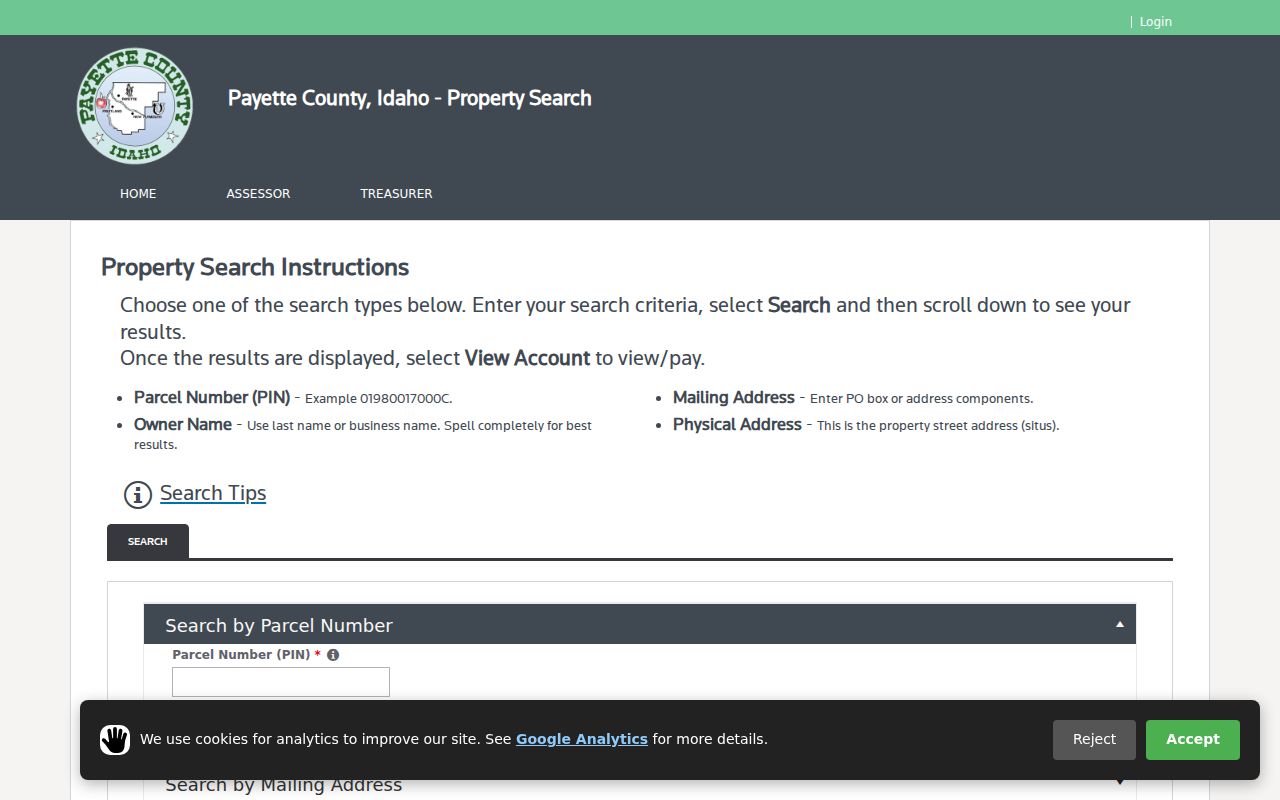
A complete PIN gives the strongest match. A short fragment helps with discovery, but confirm it before reading any values.
Payette Tax Code Geography
One Payette County parcel can sit inside several taxing districts at once. The Treasurer's district directory lists county, roads, cities, schools, fire, ambulance, cemetery, drainage, irrigation, and other local entities. The tax code area bundles the rates that apply to a single parcel.
The published 2025 levy table shows why the exact code matters. Payette sits at 0.007475931, New Plymouth at 0.007574701, and Fruitland at 0.007496844, with distinct city subareas carrying their own rates and rural code areas differing again. These are year-specific rates, not a shortcut to a current bill. Taxable value, exemptions, district membership, special assessments, and the correct period still need checking.
GIS district layers add context, but the tax account remains the billing source. Map boundaries and account codes should agree before any rate is assigned to a parcel.
Payette Homeowner Exemption
The Idaho Tax Commission homeowner exemption shields 50 percent of a qualifying home. It also covers up to one acre. The cap matches the maximum stated for the year. The published page lists a $125,000 maximum for the referenced years. Eligibility turns on the property serving as the primary home under state rules.
Read Exemption History next to Net Taxable Value. Relief can move the taxable figure even when the underlying appraisal moves differently. The exemption ends after an ownership change or a loss of eligibility. So a prior-year tax total cannot be projected forward.
Note: An exemption changes taxable value; it does not make the tax account a market appraisal or a sale record.
Continuous Payette Valuation
Idaho Code section 63-314 calls for continuous valuation. The law requires an appraisal at least once every five years. Annual indexing fills the years between them. The Idaho Tax Commission notes that assessors weigh sales, size, location, quality, age, and condition. That cycle explains why an assessed value can change with no new deed at all.
Ratio studies compare assessed values against market or sale evidence to test level and uniformity. A 100 percent assessment level represents market value in that framework. It does not force every parcel to match its latest sale. No current Payette-specific residential assessment-level figure is published. A state benchmark should not stand in as local fact.
Audit a Payette Tax-Deed Lead
A delinquency is not a transfer. Neither is a pending tax-deed notice. Only a recorded deed shows the county actually took or conveyed the parcel. Treat each stage separately when weighing a Payette County lead. A 2013 Payette notice still offers a useful field model. Preserve the PIN, situs, legal description, delinquent year, and itemized amounts from it. Never reuse that old balance for a current account. Check the Treasurer account and the county's tax-deeded-property materials. Then search the recorder for a completed deed. If court action is involved, confirm the docket and disposition.
Verify the stage. A delinquent bill or pending notice does not establish a completed tax-deed transfer.
Contest a Payette Assessment
Start with the Assessor. Pull the account and compare its characteristics, land and improvement components, photographs, condition, and any zoning or use restrictions against sound comparable transfers before turning to Idaho's Board of Equalization route if the issue remains. A quitclaim or family transfer is not market evidence.
Appeal window. File with the Board of Equalization by the fourth Monday in June. A further Idaho Board of Tax Appeals filing is due within 30 days after the BOE decision.
The Tax Commission overview lays out the first appeal route. The 2026 BTA form wants one notice per parcel. Attach the assessment notice and its envelope, owner or representative details, claimed values, grounds, and a signature. Keep proof of filing and every dated notice.
Evidence must tie to the valuation date and the subject parcel. Match the account's size, age, quality, land, improvements, and condition against valid recorded transfers and photographs. Zoning or use limits belong in the file too. So do facts about a split, merge, remodel, new construction, or correction. A nearby asking price proves nothing. Nor does a nominal family transfer or quitclaim label standing alone.
Exemption appeals need the claimed statute. Attach the required decision or notice as well. The Board of Equalization generally hears matters from the fourth Monday in June through the second Monday in July. Miss that window and the year's ordinary route may close, so confirm the current calendar with the county before filing.
Keep each tax year separate. Save the assessment notice, envelope, account capture, tax bill, payment receipt, exemption decision, photographs, comparable evidence, and every appeal filing. Note when each portal was checked. That chronology pays off when a correction, exemption change, or late payment posts after the first search.
Take conflicts to the office that owns the field. The Assessor handles parcel characteristics and roll values. The Treasurer explains bills, payments, tax code areas, and delinquency. The Clerk can confirm whether a tax deed or other instrument was recorded. A map layer adds district context. It cannot settle a billing dispute by itself.
Never merge separate tax years or code areas in a comparison. A district change, exemption, improvement, or valuation shift can make two bills differ for lawful reasons, so check the live account date before citing any tax total.